
Elephant-Goldfish Model: Better Specs From AI Agents, Reviewed With Fresh Eyes
The agent that helped you design a feature shares all your blind spots.
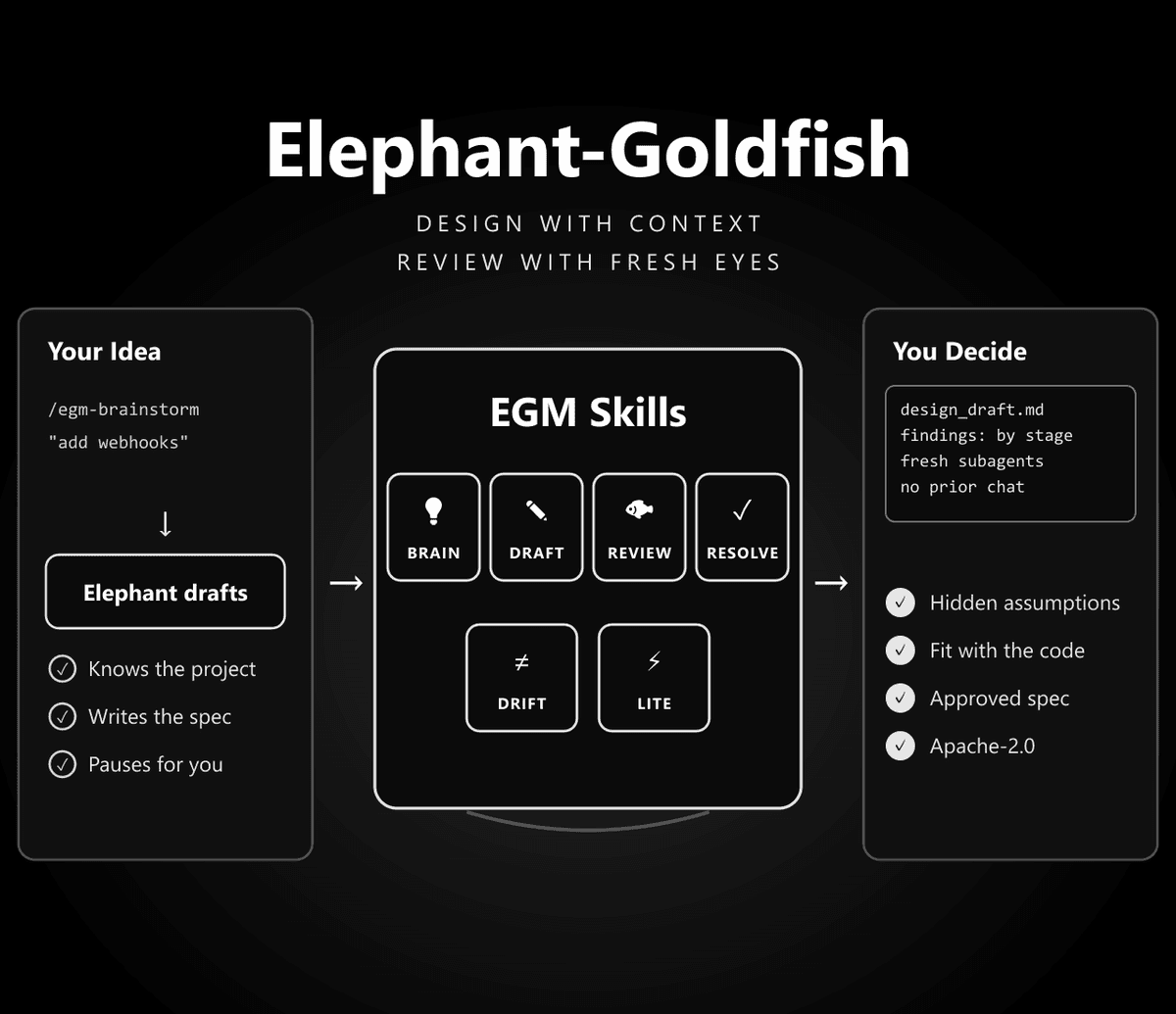
EGM gives the drafting to an "Elephant" that remembers your whole project, and the review to "Goldfish" subagents that see only the document and the code it references. You make the trade-offs and approve the spec before anything is built.
The Full Workflow
In Claude Code and Antigravity, prefix each command with /egm: (in Codex, pick the skill from the skill picker):
Discuss requirements and trade-offs; fresh reviewers challenge the idea, and the agreed direction is saved in concepts_brief.md.
Turn the brief into design_draft.md, pausing after each section for your feedback.
Goldfish reviewers check the design, its clarity, its fit with the code and the implementation plan.
Work through the findings you choose to address, then approve the design and ask your agent to implement it.
Who Holds Which Context
| Role | Sees · Does |
|---|---|
| Elephant | Your project, requirements and earlier decisions · explores the problem and drafts the spec |
| Goldfish | Only the document and its referenced sources, no earlier chat · finds missing assumptions and risks |
| You | The goals and constraints that matter · resolve trade-offs and approve what gets built |
Skills You Can Use Alone
| Skill | Use it to… |
|---|---|
| egm-review | Review an existing design doc, README or PR plan against the live code |
| egm-drift-report | Compare a folder of docs with the current source and list where they diverge |
| egm-bootstrap | Create or update documentation for an existing codebase |
| egm-lite | Fast-track small iterations, spec revisions, refactors and bug fixes |
| egm-review-loop | Run a chosen group of reviewers and standards on any document |
Install in Claude Code
claude plugin marketplace add google/elephant-goldfish-model && claude plugin install egm@egm
Start a new session after installing, then try a 60-second review on something you already have: /egm:egm-review docs/designs/webhooks.md. Install the complete plugin so its skills can read the reviewer prompts and document standards.
codex plugin marketplace add google/elephant-goldfish-model && codex plugin add egm@egm
agy plugin install https://github.com/google/elephant-goldfish-model
/egm:egm-drift-report docs/designs/
/egm:egm-brainstorm Add webhook delivery to this project.
Why a Reviewer With No Memory Helps
During a design chat, you and the agent agree on many things without writing them down. A reviewer who was part of that chat reads the spec and fills those gaps from memory. A goldfish reviewer cannot, so every requirement the document leaves implicit shows up as a question. That is exactly what a developer, or another agent, implementing the spec later would hit.
Works on Projects You Already Have
You do not need to adopt the full workflow. Point egm-review at an existing design doc or PR plan, or run egm-drift-report on your docs folder to see where documentation and code disagree. You decide whether to update the document or the code.
Limits to Plan Around
From the README and setup docs:
- Needs fresh subagents: If your agent cannot start fresh subagent contexts, EGM stops the review instead of running reviewers that remember the chat.
- Not an official Google product: It is open source in Google's organization, but the README says it is not an officially supported Google product.
- Reviews are not tests: The README states that a review does not replace tests or human judgment.
- Command prefixes vary: Some Antigravity CLI versions need the /egm: prefix to find a command; keep it to be safe.
Based on Dave Rensin's essay "Elephants, Goldfish and the New Golden Age of Software Engineering".
egm.dev and the repository's getting_started.md, harnesses.md and architecture docs.
Apache 2.0. Free for commercial use.
Frequently Asked Questions
What do "elephant" and "goldfish" mean in EGM?
The elephant remembers everything: it holds your project context and drafts the specification. The goldfish remembers nothing: reviewers read only the draft and the source material it references, so they spot assumptions the drafting conversation took for granted.
Do I have to write a new spec to try it?
No. You can review an existing design document, README or PR plan saved as Markdown with egm-review, or compare a folder of docs with the current code using egm-drift-report.
Is EGM an official Google product?
It is published in Google's GitHub organization under Apache 2.0, but the README states it is not an officially supported Google product.
Why does a review stop with an error in my agent?
Goldfish reviews need fresh subagent contexts. If your agent or harness cannot create them, EGM stops the review instead of running reviewers that can see the earlier conversation.